Palabra Text-to-Speech API Review — Is It Worth It? [2026]
.jpg)
Palabra Text-to-Speech API
A TTS API tuned for real-time voice agents, where the metric that matters is how quickly the first sound comes out, not how pretty the studio voice is.
Is Palabra's TTS API worth it?
If you run a voice agent and the pause before the bot speaks is what users complain about, yes, this deserves a test. Palabra quotes about 35 ms to first audio at P90 (excluding network), starts synthesizing after just two or three words, and accepts streamed text straight from an LLM. It also clones a voice from 3 seconds of audio and can strip the accent when the cloned voice speaks another language. Pricing is $0.03 per 1,000 characters with no concurrency caps. The catch is that the competitor comparison numbers on the page are Palabra's own, and the site itself says ElevenLabs optimizes for studio-quality English while Palabra targets production voice agents.
Speed first, polish second
Most TTS services wait for a full sentence before they start speaking, which Palabra says adds 300 to 800 ms of dead air. Its approach is to begin after two or three words and stream audio back as text keeps arriving. It supports native G.711 mu-law and PCM output, so it fits telephony as well as web, and it runs in the cloud, self-hosted or on-premises.
What you get
About 35 ms to first audio
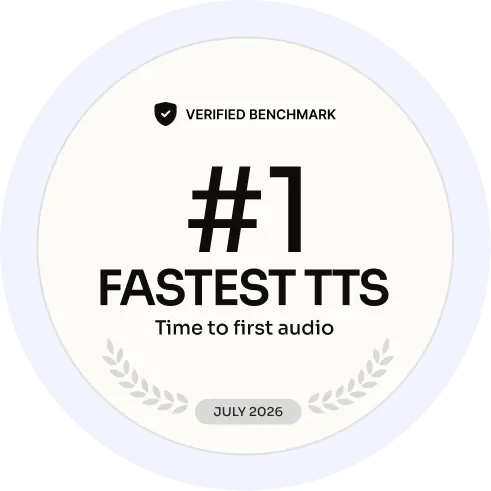
The site quotes a P90 of roughly 35 ms excluding network latency, and shows a #1 fastest TTS badge from a July 2026 benchmark. Treat it as a strong lead to verify, not a guarantee for your setup.
Text in as it is being written
You can stream text to the WebSocket straight from an LLM or a live transcript. That is the part that removes the sentence-buffer delay in agent pipelines.
Voice clone from 3 seconds of audio
No fine-tuning step. Real-time deaccenting lets an English-cloned voice speak German without sounding like an English speaker doing German, which is a neat trick for multilingual agents.
Drop-in for common agent stacks
Palabra lists compatibility with Vapi, Retell, LiveKit, Pipecat and Vocode, so you are not writing glue code from scratch.
Full spec sheet
| Pricing | $0.03 per 1,000 characters |
| Time to first audio | ~35 ms P90, excl. network (vendor claim) |
| Languages | 21 |
| Voice cloning | 3 seconds of reference audio |
| Input | Streaming text over WebSocket |
| Audio formats | G.711 mu-law, PCM |
| Concurrency | No caps stated |
| Integrations | Vapi, Retell, LiveKit, Pipecat, Vocode |
| Deployment | Cloud, self-hosted, on-premises |
| SLA | 99.9% (stated) |
Pros & Cons
Pros
- Very low quoted latency, with streaming input to match.
- Voice cloning included, no extra fine-tuning.
- Deaccenting is genuinely useful for multilingual agents.
- Transparent per-character pricing and no concurrency caps.
- Works with the popular voice-agent frameworks.
Cons
- Only 21 languages, compared with 60+ for Palabra's translation API.
- Benchmark comparisons on the page are vendor-published.
- Positioned for production voice agents rather than studio-quality English narration.
- Per-character billing needs a quick calculation for long-form content.
Answers before you buy
How is it priced?
How fast is it really?
Which languages are supported?
What is deaccenting?
Does it work over the phone?
Built for voice agents, and it shows
If low latency and multilingual cloning matter more to you than studio polish, Palabra's TTS API is worth a free-credit test. Verify the speed claims on your own stack.
This page contains affiliate links. Teelacodes may earn a commission when you click through and complete a qualifying purchase, at no extra cost to you. Read the full disclosure policy. Prices, stock and promotion terms can change without notice — always confirm the final total and availability on palabra.ai before ordering.
Popular Blog